Securing the Multi-Cloud: Enterprise Cybersecurity Strategies for AWS, Azure, and GCP

Deploying enterprise-grade security tools is only half the battle; configuring them without breaking production workflows requires seasoned cloud architects.

Cloud adoption across India has shifted from a competitive advantage to an operational baseline. Whether you run high-frequency financial transactions in Mumbai, manage healthcare data in Bengaluru, or scale SaaS engineering teams out of Kochi and Thiruvananthapuram, your infrastructure likely spans multiple providers.

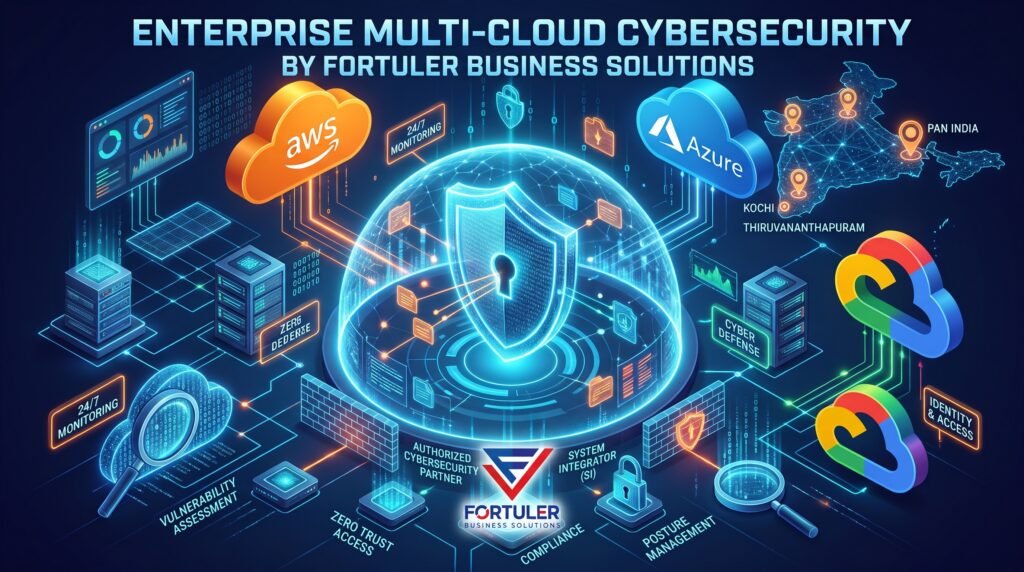
However, distributing workloads across Amazon Web Services (AWS), Microsoft Azure, and Google Cloud Platform (GCP) introduces a critical vulnerability: fragmented visibility. Attackers actively exploit the seams between platforms, targeting misconfigured storage buckets, overly permissive Identity and Access Management (IAM) roles, and unmonitored APIs. Relying on default provider settings is no longer a viable defense strategy.

Understanding the Shared Responsibility Trap

A common misconception among rapidly scaling enterprises is assuming the cloud provider secures everything. In reality, AWS, Azure, and GCP operate under the Shared Responsibility Model. They secure the physical data centers, hypervisors, and underlying networking security of the cloud.

Your organization is entirely responsible for security in the cloud. This includes:

  • Encrypting data at rest and in transit.

  • Configuring network firewalls and Virtual Private Clouds (VPCs).

  • Managing user access, service accounts, and API keys.

  • Patching guest operating systems and containerized workloads.

When an organization operates a hybrid or multi-cloud environment, multiplying these responsibilities across three different consoles creates severe configuration drift.

Platform-Specific Security Architecture

Effective cloud defense requires leveraging native security telemetry while unifying control planes across vendors. Each major hyperscaler offers distinct architectural strengths that must be properly calibrated:

  • Amazon Web Services (AWS): Beyond standard IAM policies, mature AWS deployments require centralized threat detection using Amazon GuardDuty and AWS Security Hub. Enforcing least-privilege access via Service Control Policies (SCPs) across AWS Organizations prevents lateral movement if a single EC2 instance or Lambda function is compromised.

  • Microsoft Azure: For enterprises deeply integrated with Microsoft Entra ID (formerly Azure AD), identity is the primary perimeter. Implementing Microsoft Defender for Cloud alongside Conditional Access policies and Privileged Identity Management (PIM) ensures just-in-time administrative access and continuous vulnerability assessment.

  • Google Cloud Platform (GCP): GCP’s default encryption and BeyondCorp zero-trust architecture provide a strong foundation. Hardening GCP involves configuring Security Command Center (SCC), enforcing VPC Service Controls to prevent data exfiltration, and utilizing Binary Authorization to ensure only trusted container images deploy on Google Kubernetes Engine (GKE).

Bridging the Gap with Unified Cloud Security

Managing three separate security ecosystems strains internal IT teams and leads to alert fatigue. To protect mission-critical assets across all industry verticals from manufacturing and logistics to fintech and IT/ITeS—organizations must implement a unified security posture:

  • Cloud Security Posture Management (CSPM): Continuously scan AWS, Azure, and GCP environments to automatically detect and remediate misconfigurations, such as publicly exposed S3 buckets or open RDP/SSH ports.

  • Cloud Workload Protection Platforms (CWPP): Secure virtual machines, containers, and serverless functions at runtime, detecting behavioral anomalies before ransomware executes.

  • Automated Compliance Enforcement: Maintain continuous alignment with global and regional frameworks, including ISO 27001, SOC 2, GDPR, and India’s Digital Personal Data Protection (DPDP) Act.

  • 24/7 Managed Detection and Response (MDR): Pair automated cloud-native telemetry with human threat hunters who investigate, contain, and neutralize active breaches in real time.

Do not wait for a compliance audit or a security breach to test your cloud defenses. Contact our cloud security architects today to schedule a comprehensive Multi-Cloud Vulnerability & Posture Assessment.

SecOps, intelligence, AI, and cloud security

GoogleCloud_Fortuler

Google Cloud

Accelerate Your Digital Evolution with Fortuler & Google Cloud We move your legacy systems to GCP with zero data loss and minimal downtime. Say goodbye

AWS Fortuler Reseller

Amazon Web Services -AWS

Scaling Infrastructure: Why You Need an AWS Fortuler Partner AI and cloud computing services Use Cases for Cloud Hosting Our Services Partnering with an authorized AWS Partner

Microsoft Azure

Cloud Computing Services Microsoft Azure See how AI strategy meets real-world execution Contact Us Our Services Empower your digital transformation with Fortuler, your dedicated Microsoft

Contact us today for a comprehensive Multi-Cloud Vulnerability & Posture Assessment

Thank you! We will contact you soon.